
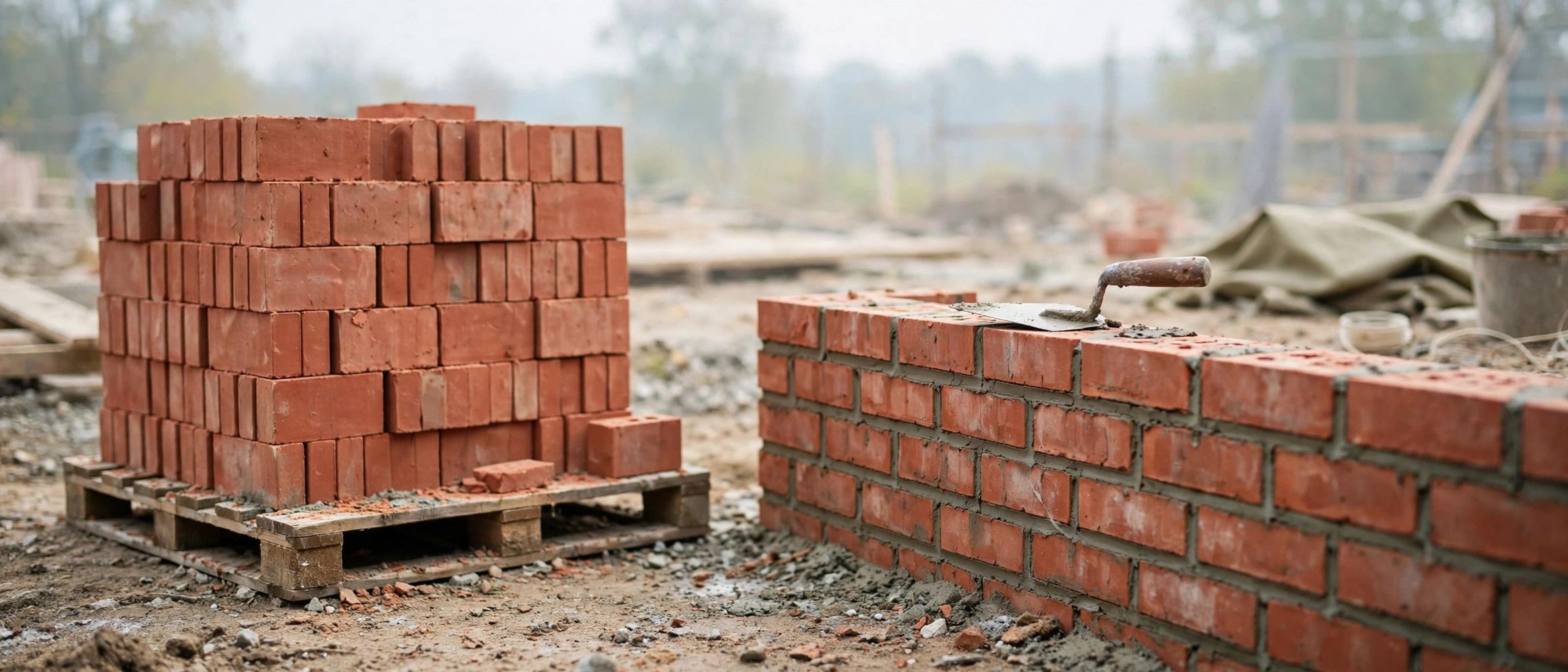
The Method: One Brick, One Joint, One Volume
A standard modular brick measures 190 x 90 x 90 mm. Laid in a wall, the brick never sits alone: a 10 mm mortar joint wraps it, and the unit the wall actually consumes is 200 x 100 x 100 mm, which is 0.002 cubic meters. Divide any wall volume by that unit and the count follows: 500 bricks per cubic meter of finished wall, before wastage. The whole calculator is that one division, applied honestly.
The wall side of the division is plain volume. Length times height gives the face area; subtract the doors and windows, because a hole holds no bricks; multiply by the thickness, 0.2 m for a single brick wall or 0.1 m for a half brick partition. A 3 m by 3 m wall at 200 mm holds 1.8 cubic meters of wall, and 1.8 times 500 is 900 bricks. Every count on this page, in the tool and in the tables, is the same two multiplications.
The joint is the part beginners leave out, and the omission is not small. A count built on the raw brick volume alone, with no mortar, overstates the same wall by about a fifth. The mortar article below reconstructs the day that lesson arrived on my own wall, course by course.
Bricks Per Cubic Meter, Per Square Meter, Per Square Foot
The table below states the rates the method produces at the standard brick size and a 10 mm joint, in the three units readers measure in.
| Measure | 100 mm partition wall | 200 mm single brick wall |
|---|---|---|
| Bricks per cubic meter of wall | 500 | 500 |
| Bricks per square meter of wall face | 50 | 100 |
| Bricks per square foot of wall face | About 4.6 | About 9.3 |
The cubic meter rate never changes with thickness, because it prices volume, and volume is volume. The face rates carry the thickness inside them: double the thickness doubles the bricks behind every square meter of face, from 50 to 100. A reader who knows a wall's face area and its thickness already holds the whole calculation, and the per-square-foot row serves the readers who measure rooms in feet, as most households here do.
Common Walls, Counted In Advance
The table below counts the walls readers ask about most, at both standard thicknesses, with the order quantity at 5 percent wastage beside the laid count. The boundary row assumes a standard 5 marla plot perimeter of 150 feet with a gate opening of 30 square feet deducted, and the plot dimensions behind that perimeter stand stated because plot shapes vary by city.
| Wall | Thickness | Bricks laid | Order at 5% wastage |
|---|---|---|---|
| Room wall, 10 ft x 10 ft | 200 mm | 929 | 975 |
| Room wall, 10 ft x 10 ft | 100 mm | 465 | 488 |
| Room wall, 10 ft x 12 ft | 200 mm | 1,115 | 1,171 |
| Room wall, 10 ft x 12 ft | 100 mm | 557 | 585 |
| Boundary wall, 5 marla plot, 150 ft perimeter, 7 ft high, gate deducted | 200 mm | 9,476 | 9,950 |
| Boundary wall, 5 marla plot, 150 ft perimeter, 7 ft high, gate deducted | 100 mm | 4,738 | 4,975 |
Run your own wall through the tool rather than borrowing a row. Two walls with the same face area and different openings differ by the full count of their holes, and the boundary article below works a complete 5 marla perimeter from the plot plan to the kiln order, gate and all.
The Mortar That Goes With The Bricks
A wall is bricks and the mortar between them, and the mortar share is large enough to stop work when nobody estimates it. The tool estimates mortar by volume balance. The bricks inside one cubic meter of wall occupy 500 times the raw brick volume, 0.7695 cubic meters. The rest of the wall, 0.2305 cubic meters, is wet mortar. Dry mortar runs at 1.30 times the wet volume, about 0.30 cubic meters, to allow for voids and bulking. At a 1:4 mix, the cement share of that dry volume at a density of 1440 kg per cubic meter gives the bag count, and the sand share gives the sand volume.
The worked example in the tool's default wall shows the chain at household scale. A 3 m by 3 m wall at 200 mm holds 900 bricks. The bricks occupy 1.385 cubic meters of the wall's 1.8, leaving 0.41 cubic meters of wet mortar and 0.54 of dry. At 1:4, the cement comes to about 155 kg, which is 3.1 bags of 50 kg, and the sand to 0.43 cubic meters. A 1:6 mix, the leaner mortar partitions often use, lowers the cement share and raises the sand; the tool's mix selector reruns the same balance.
Estimates wear their name honestly here. Mortar consumption shifts with joint thickness, brick absorption, and the mason's hand, and the figures above are the standard rate-analysis estimate, stated with its method so a builder can argue with the inputs instead of with the answer.
Three Walls Worked In Full
Wall one is the tool's default: 3 m long, 3 m high, 200 mm thick, no openings. Face area 9 square meters, volume 1.8 cubic meters, bricks 900, order at 5 percent wastage 945. Mortar at 1:4: 0.41 cubic meters wet, 0.54 dry, 3.1 bags of cement, 0.43 cubic meters of sand, each figure derived in the mortar section above.
Wall two stretches the same room: 4 m by 3 m at 200 mm. Face area 12 square meters, volume 2.4 cubic meters, bricks 1,200, order 1,260 at the same wastage. One added meter of length adds exactly 300 bricks, because the rate is linear, and a reader can sanity-check any calculator with that observation alone.
Wall three crosses unit systems: 12 ft by 9 ft at 200 mm, the wall as an imperial tape reports it. In meters the wall is 3.6576 by 2.7432, face area 10.03 square meters, volume 2.007 cubic meters, bricks 1,003, order 1,054. The tool's feet-and-inches mode performs this conversion internally, so a household that measures in feet never has to carry a decimal of a meter through the arithmetic by hand.
Why Brick Prices Refuse A National Average
Brick is a local material. Clay, coal, labor, and the short road from kiln to site set the price, and the price per thousand first-class bricks differs between cities by margins that make any single national figure misleading for every reader at once. The chart structure below holds one candle per city, low, typical, and high price per 1,000 first-class bricks, drawn from local market listings and two named supplier sources per city, dated on the page at each audit.
The spread inside one candle is the honest part of the chart. A single city can move thousands of rupees per thousand bricks across one season as coal prices and demand shift, and a buyer quoted outside the band for their city and their month has a question to ask the supplier, armed with the band itself.
Why I Built This Calculator
When the boundary wall of my family plot in Multan went up, the mason ordered by habit and by eye, the way his father had ordered before him. The wall finished beautifully. Beside it stood a leftover pile of bricks large enough to feel like a second, smaller wall, and the family paid to move bricks twice: once to the plot, and once away from it.
I counted the bricks actually laid in one completed stretch of that wall and ran the volume method backwards from the count. The two figures met within a few bricks. The method was not the problem, and neither was the mason, whose eye had built a sound wall. The missing piece was a ten-minute calculation nobody had run before the order, because every tool I found afterward assumed American brick sizes or hid its mortar logic entirely, and a hidden method cannot argue with a confident estimate at a kiln.
This calculator runs on the count from my own wall. The brick size field accepts the brick your kiln actually sells, measured with your tape. The openings field subtracts the doors and windows before the count, not after the delivery. The wastage is a number you choose and can defend, in place of a padded guess nobody can explain to the person paying.
The three methods were the cubic meter rate, the square meter rate, and a course-by-course count of one laid stretch, run later during a room extension at my own house. They landed within a handful of bricks of each other. Any one of them would have saved the leftover pile; together they became the standard every figure on this page has to meet. Three methods, one wall, one answer. After that day I stopped accepting estimates that arrive without arithmetic.
More Guides On Bricks And Walls
- How Many Bricks In A 10 By 10 Wall: One Count, Checked Three Ways
- Half Brick Or Full Brick Wall: What The Thickness Choice Changes
- Why The Mortar Joint Decides Your Brick Count More Than The Brick Does
- Brick Sizes In Pakistan And India: Why The Calculator Asks Which Brick You Bought
- Ordering Bricks: Wastage, Breakage On The Road, And The Honest Extra Percentage
- Bricks For A Boundary Wall Around A 5 Marla Plot, Worked End To End
- The Mortar That Goes With The Bricks: Cement And Sand For The Same Wall
- Counting Bricks For A Wall With A Door And Two Windows
- First Class, Second Class, Third Class: What Kiln Grades Mean For Your Wall
- Before The Truck Leaves The Kiln: A Brick Order Checklist
Plot dimensions behind a boundary wall start on the marla to square feet converter.
Questions People Ask About This Page
Does The Brick Count Include The Mortar?
Yes, through the joint size. Each brick is counted at its size plus the 10 mm mortar joint on each face, so a standard brick occupies 200 x 100 x 100 mm of wall. A count built on the raw brick size alone overstates the wall by roughly a fifth, and the mortar article below shows that error in full.
How Many Bricks Are In One Cubic Foot Of Wall?
About 14 bricks. One cubic meter holds 500 standard bricks with joints, and one cubic meter is 35.315 cubic feet, so the division gives 14.2 bricks per cubic foot. Readers who measure a wall in feet can switch the tool to feet and inches and skip the hand conversion entirely.
What Wastage Percentage Is Honest?
Five percent covers a careful site with short transport, and up to 10 percent is honest when bricks travel a long road or the wall needs many cuts. The three losses are different in kind: cutting waste at the wall, breakage on the road, and underfired bricks rejected at the stack. The ordering article below prices each one separately.
Do Local Pakistani Brick Sizes Change The Count?
Yes. Kiln bricks in Pakistan often run longer or thicker than the 190 mm modular standard, and a larger brick fills the wall with fewer pieces. The tool's brick size field accepts your own measured dimensions, so measure one brick from your stack and let the count follow your brick rather than the textbook one.
Should Pillars And Beams Be Deducted From The Wall?
Yes, roughly, through the same openings field. Concrete pillars and ring beams occupy wall volume that holds no bricks, so measure their total face area and enter it with the doors and windows. The deduction is an estimate, and it is far closer than pretending the frame is brick.
Facts, Checked Against Trusted Sources
- Brickwork estimating in Indian public works practice uses about 500 bricks per cubic meter with standard mortar joints, the basis of the CPWD analysis of rates for building works. Source: Central Public Works Department, Analysis of Rates for Building Works
- Mortar joints in standard brickwork practice run at 10 mm, which is what turns the nominal 190 x 90 x 90 mm brick into the 200 x 100 x 100 mm estimating unit behind the count. Source: Central Public Works Department, specifications for building works


