How the grams to cups conversion works
Cups equal grams divided by the ingredient's grams per cup. That single line runs the whole page. A cup measures volume, and a gram measures weight, so the ingredient itself forms the bridge between the two units. Honey packs 340 g into one cup. Rolled oats hold only 80 g in the same cup. The converter above stores a tested density for each of the 16 ingredients on this page and divides or multiplies by that number, and it prints the density inside the result so you can audit the math yourself.
The direction matters less than the ingredient. Grams to cups divides by the density. Cups to grams multiplies by the same density. A reader who converts 250 g of flour with the sugar density gets a confident, wrong answer, and that error sits behind a large share of failed bakes. Pick the ingredient first, every time.
The ingredient density table
The table below lists every ingredient the converter handles, the weight of one level US cup, and the cup value of 100 g for quick mental checks.
| Ingredient | Grams per cup | Cups in 100 g |
|---|---|---|
| All-purpose flour | 120 g | 0.83 |
| Granulated sugar | 200 g | 0.50 |
| Brown sugar (packed) | 220 g | 0.45 |
| Butter | 227 g | 0.44 |
| Powdered sugar | 120 g | 0.83 |
| Water | 237 g | 0.42 |
| Milk | 237 g | 0.42 |
| Rolled oats | 80 g | 1.25 |
| Rice (uncooked) | 185 g | 0.54 |
| Chocolate chips | 160 g | 0.63 |
| Honey | 340 g | 0.29 |
| Almonds (chopped) | 140 g | 0.71 |
| Cocoa powder | 100 g | 1.00 |
| Table salt | 292 g | 0.34 |
| Baking powder | 192 g | 0.52 |
| Vegetable oil | 224 g | 0.45 |
The spread runs from 80 g to 340 g for the same cup, and that spread is the whole argument against generic charts. The bar chart below ranks the same values so the gap stays visible.
Flour: grams to cups table
Flour drives more searches than any other ingredient, so flour gets its own table, worked at the 120 g spooned and leveled standard.
| Flour (g) | Cups | Flour (g) | Cups |
|---|---|---|---|
| 10 g | 0.08 | 250 g | 2.08 |
| 25 g | 0.21 | 300 g | 2.50 |
| 50 g | 0.42 | 400 g | 3.33 |
| 100 g | 0.83 | 500 g | 4.17 |
| 125 g | 1.04 | 750 g | 6.25 |
| 200 g | 1.67 | 1,000 g | 8.33 |
Sugar: grams to cups table
Granulated sugar sits at 200 g per cup, so its table reads cleaner than flour and still trips readers who borrow the flour numbers.
| Sugar (g) | Cups | Sugar (g) | Cups |
|---|---|---|---|
| 10 g | 0.05 | 250 g | 1.25 |
| 25 g | 0.13 | 300 g | 1.50 |
| 50 g | 0.25 | 400 g | 2.00 |
| 100 g | 0.50 | 500 g | 2.50 |
| 125 g | 0.63 | 750 g | 3.75 |
| 200 g | 1.00 | 1,000 g | 5.00 |
Butter: grams, cups, and sticks table
Butter confuses two systems at once, because US recipes measure it in sticks while the rest of the world weighs it. One stick equals 113.5 g, and two sticks equal one cup at 227 g.
| Butter (g) | Cups | Sticks |
|---|---|---|
| 57 g | 0.25 | 0.5 |
| 113.5 g | 0.50 | 1 |
| 170 g | 0.75 | 1.5 |
| 227 g | 1.00 | 2 |
| 340 g | 1.50 | 3 |
| 454 g | 2.00 | 4 |
Common amounts across five ingredients
The five amounts readers search most, placed side by side for the five ingredients readers search most, show why a single memorized number fails.
| Amount | Flour | Sugar | Butter | Honey | Cocoa |
|---|---|---|---|---|---|
| 50 g | 0.42 cups | 0.25 cups | 0.22 cups | 0.15 cups | 0.50 cups |
| 100 g | 0.83 cups | 0.50 cups | 0.44 cups | 0.29 cups | 1.00 cups |
| 125 g | 1.04 cups | 0.63 cups | 0.55 cups | 0.37 cups | 1.25 cups |
| 200 g | 1.67 cups | 1.00 cups | 0.88 cups | 0.59 cups | 2.00 cups |
| 250 g | 2.08 cups | 1.25 cups | 1.10 cups | 0.74 cups | 2.50 cups |
The range candles below show the lightest and heaviest realistic cup for five staples, with the standard density as the candle body. A wide candle marks an ingredient that punishes careless measuring.
Worked examples
250 g of flour. The converter divides 250 by 120 and returns 2.08 cups. On a measuring cup that reads as 2 cups plus 1 tablespoon plus 1 teaspoon, and the converter prints that kitchen form beside the decimal.
100 g of cocoa powder. Cocoa sits at exactly 100 g per cup, so 100 g returns 1.00 cup. Cocoa is the one ingredient where the gram number and the cup number agree, and readers often assume every ingredient behaves the same way. Only cocoa does.
2 cups of honey, reversed. The cups to grams direction multiplies 2 by 340 and returns 680 g. A cook who weighs honey instead of greasing a cup gets the full amount out of the jar and into the bowl, with nothing lost to the cup walls.
Three ways to fill a cup of flour
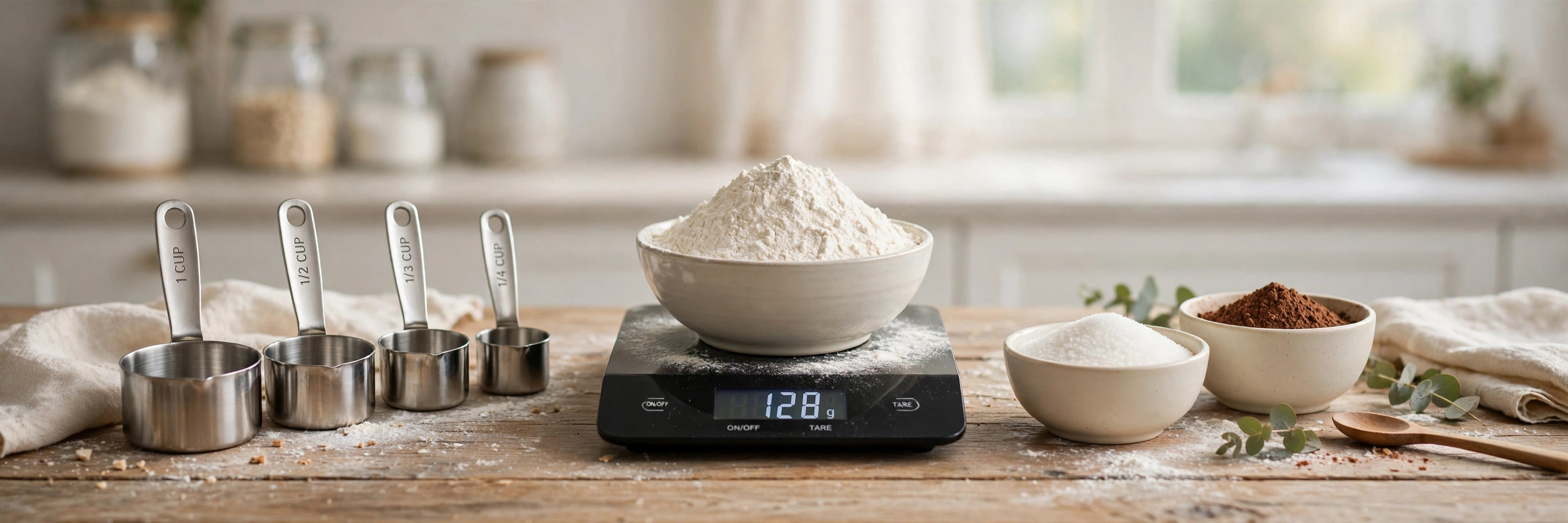
The same cup of flour carries three different weights, and the method picks the weight. Sifted flour lands near 110 g per cup. Spooned and leveled flour, the method King Arthur Baking builds its chart on, lands at 120 g. A cup scooped straight from the bag packs down and lands near 140 g. The recipe author assumed one of those numbers, and the gap between the assumed number and your method decides whether the crumb turns out tender or tight. Weighing removes the guess entirely, and readers without a scale get the closest match by spooning flour into the cup and leveling the top with a knife.
Common mistakes
- One number for every ingredient. A chart that claims 1 cup equals 240 g serves water and fails flour by half.
- Scooping flour from the bag. The scoop compacts the flour and adds up to 20 g per cup beyond the standard the recipe assumed.
- Treating a butter stick as a cup. A stick holds 113.5 g, and a cup holds 227 g, so the swap doubles the fat in the recipe.
- Measuring brown sugar loose. Recipes mean packed brown sugar at 220 g per cup, and a loose cup falls far short.
- Mixing cup systems. A metric cup holds 250 mL against the US cup at 236.588 mL, and the 5 percent gap grows across a big batch.
Why I built this converter
My mother's birthday cake collapsed on one side, and the recipe was not at fault. The cake came from an American blog, the recipe called for 2 cups of flour, and I filled both cups the fast way, scooping straight from the bag and shaking them level. The batter looked right. The oven did its work. The cake rose, leaned, and sank on one side like a tent with a cut rope.
Out of plain stubbornness, I weighed a scooped cup the next morning. The scale read close to 140 g. The recipe had assumed the 120 g cup that spooned and leveled measuring gives. Across two cups I had added about 40 g of flour the recipe never asked for, and the extra flour pulled the crumb tight on the heavier side. Nobody had lied to me. The word cup had simply carried two different weights, and I had picked the wrong one.
I built the density table for my own kitchen first. The table lived on paper inside a cupboard door for months before it became a web page, and my family still checks the paper version. The converter above is that table with a keyboard attached, and every value in it still answers to the scale on my counter. That 20 g gap between my scooped cup and the recipe's cup is also why the converter prints the density inside every result: the number that sank my mother's cake now travels with every answer the tool gives, so nobody has to take a conversion on faith the way I did.
Read next
- I scooped my flour straight from the bag and weighed what it cost my cake
- Converting my aunt's American butter cake for a kitchen that weighs everything
- One cup of honey weighs almost three cups of flour, and that is the whole problem
- Tripling a brownie recipe for a family dawat without breaking the batter
- No scale, no problem: I tested cup-only measuring in a hostel kitchen
- Packed brown sugar is an instruction, not a suggestion: I weighed both ways
- A reader's cookies spread flat, so we traced the fat measurement
- My sister in Texas asked for my cardamom cake in cups, so I translated my own recipe
- Five kitchen tools, one honest ranking: what actually fixed my measurements
- How I built the 15-ingredient density table, and where the big sources disagreed
Questions people ask about this page
Why do the same grams give different cups for different ingredients?
A cup measures volume and a gram measures weight, so the bridge between them is density. One cup of honey weighs 340 g because honey packs a lot of mass into the cup, while one cup of rolled oats weighs 80 g because the flakes trap air. The ingredient decides the conversion, and no single number can serve every ingredient.
What changes when flour is scooped instead of spooned and leveled?
Scooping packs the flour down inside the cup. A spooned and leveled cup of all-purpose flour weighs 120 g, and a cup scooped straight from the bag can reach about 140 g. That extra flour dries out cakes and tightens bread dough, so the converter uses the spooned and leveled standard for flour.
Is a US cup the same as a metric cup?
No. A US customary cup holds 236.588 mL and a metric cup holds 250 mL, a gap of about 5 percent. The FDA legal cup used on nutrition labels holds 240 mL. This converter uses the US customary cup, and a reader working with Australian or metric-cup recipes should expect results to drift by roughly that 5 percent.
How can I convert grams to cups without a kitchen scale?
Use the ingredient charts on this page and build the amount from tablespoons, since one cup holds 16 tablespoons. The method works well for flour, sugar, and cocoa, and it loses accuracy with chunky ingredients such as chocolate chips. A basic digital scale still beats every workaround, and it pays for itself in saved ingredients.
Why do US recipes sell butter by the stick instead of by the cup?
A US butter stick is a quarter pound of butter, which is 113.5 g, and the wrapper prints tablespoon marks along its length. Two sticks make one cup, or 227 g. A recipe that says one stick wants 113.5 g, and a reader who treats a stick as a cup doubles the fat in the pan.
Does this chart work for British recipes?
Yes, for the weights. British recipes already print grams, so the chart matters when a British baker meets an American recipe written in cups. The density values do not change across the Atlantic. Only the cup size can differ, and British cooks who weigh ingredients avoid the question entirely.
Facts, checked against trusted sources
- The US legal cup used on FDA nutrition labels holds 240 mL, while the customary US cup holds 236.588 mL, so a labeled cup and a kitchen cup are not quite the same measure. Source: US Food and Drug Administration, 21 CFR 101.9
- King Arthur Baking sets one cup of all-purpose flour at 120 g and builds its ingredient weight chart on flour that is spooned into the cup and leveled. Source: King Arthur Baking ingredient weight chart
- USDA FoodData Central lists weight data for standard cup portions of raw ingredients, and its figures put a cup of water or milk at about 237 g. Source: USDA FoodData Central