How the Gas Mark conversion works
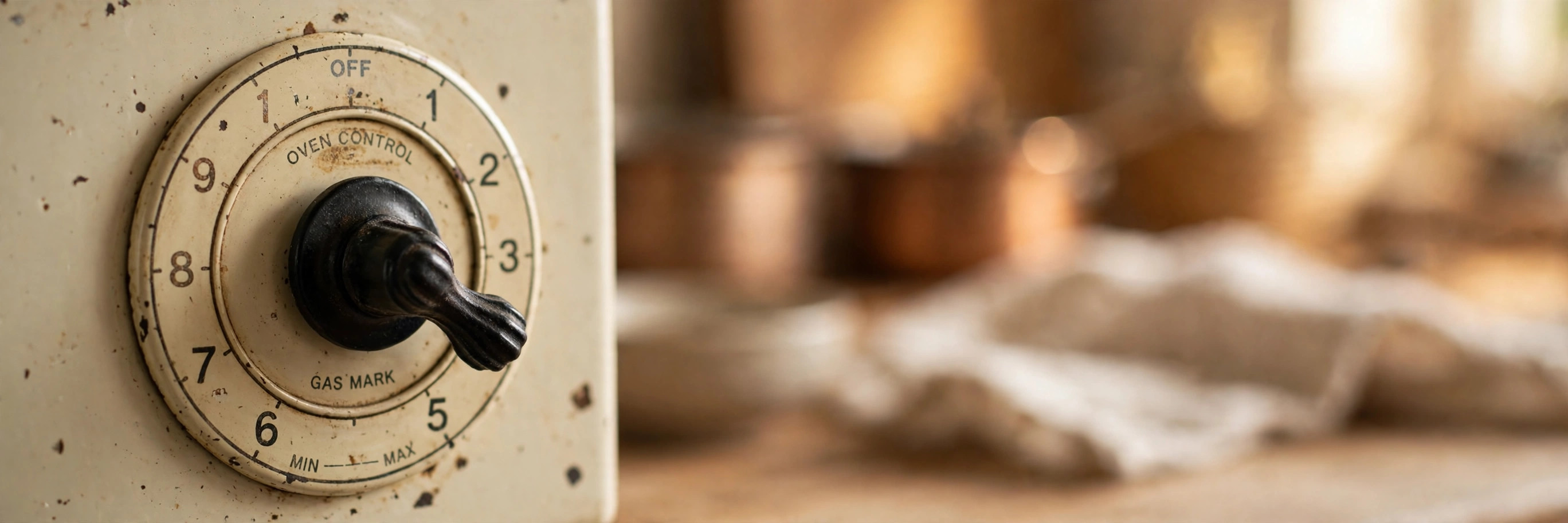
Gas Mark 4 equals 180 °C and 350 °F, and every other mark steps from that anchor. Gas Mark is the dial scale of the Regulo thermostat, the control fitted to British gas cookers for most of the twentieth century. The scale runs from 1/4 to 9, and the marks do not climb in even Celsius steps, so a formula alone cannot replace the table. The converter above holds the standard published table, mark by mark, and it adds the fan oven value by the usual rule of 20 °C below the conventional Celsius figure.
Fahrenheit follows the exact relation for every entry: the Celsius value multiplied by 9/5, plus 32. The table rounds Fahrenheit to the familiar recipe numbers, so Gas Mark 3 prints as 325 °F, the figure British and American books have used for decades.
The full Gas Mark conversion table
The complete standard table runs from Gas Mark 1/4 to Gas Mark 9, with the conventional Celsius, the Fahrenheit, the fan oven Celsius, and the name cooks gave each heat.
| Gas Mark | Celsius | Fahrenheit | Fan oven (°C) | Description |
|---|---|---|---|---|
| 1/4 | 110 °C | 225 °F | 90 °C | Very slow |
| 1/2 | 120 °C | 250 °F | 100 °C | Very slow |
| 1 | 140 °C | 275 °F | 120 °C | Slow |
| 2 | 150 °C | 300 °F | 130 °C | Moderately slow |
| 3 | 170 °C | 325 °F | 150 °C | Moderate |
| 4 | 180 °C | 350 °F | 160 °C | Moderate |
| 5 | 190 °C | 375 °F | 170 °C | Moderately hot |
| 6 | 200 °C | 400 °F | 180 °C | Fairly hot |
| 7 | 220 °C | 425 °F | 200 °C | Hot |
| 8 | 230 °C | 450 °F | 210 °C | Hot |
| 9 | 240 °C | 475 °F | 220 °C | Very hot |
The line chart below plots the same table, and the uneven steps stay visible: the marks bunch at the slow end, where control matters most, and stretch at the hot end.
Celsius values readers search most
Most reverse searches start from a round Celsius figure in a modern recipe and end at a British dial, so the ten common values sit in one short table.
| Celsius | Gas Mark | Celsius | Gas Mark |
|---|---|---|---|
| 110 °C | 1/4 | 190 °C | 5 |
| 120 °C | 1/2 | 200 °C | 6 |
| 140 °C | 1 | 220 °C | 7 |
| 150 °C | 2 | 230 °C | 8 |
| 180 °C | 4 | 240 °C | 9 |
Fan oven quick table
Fan ovens move hot air onto the food, so the same bake needs less heat on the dial. The standard guidance subtracts 20 °C from the conventional figure for the five marks home bakers use most.
| Gas Mark | Conventional (°C) | Fan oven (°C) |
|---|---|---|
| 2 | 150 °C | 130 °C |
| 3 | 170 °C | 150 °C |
| 4 | 180 °C | 160 °C |
| 5 | 190 °C | 170 °C |
| 6 | 200 °C | 180 °C |
A few oven makers suggest a 10 °C reduction instead of 20 °C. The manual for your oven outranks any general table, and the first bake with a new oven deserves a thermometer check before you trust either figure.
Worked examples
Gas Mark 4, conventional oven. The table returns 180 °C and 350 °F, the everyday baking setting. The same recipe in a fan oven takes 160 °C, and the converter prints that value in the same result so nobody has to do the subtraction with flour on their hands.
Gas Mark 6, conventional oven. The table returns 200 °C and 400 °F, the roasting range. The fan value drops to 180 °C. A cook who sets 200 °C in a fan oven runs the roast a full mark hot, and the outside chars before the center arrives.
220 °C, reversed. A modern recipe that asks for 220 °C lands on Gas Mark 7, at 425 °F. The reverse direction answers the diaspora question: Pakistani and Indian recipes print Celsius, British dials print marks, and families convert this one value more than any other.
Why two ovens at the same mark bake differently
A thermostat does not hold one temperature. The burner or element cycles, the air inside swings above and below the set point, and the swing at Gas Mark 4 can span 15 to 20 °C in an older cooker. The data candles below record one oven at Gas Mark 4 across a forty minute preheat and bake, logged in five minute windows against the 180 °C target. Each candle shows the low and high reading in its window, and the pattern explains why a cake that works in your mother's oven sulks in yours: the dials agree, and the air inside does not.
Old recipe words and the marks they mean
Recipes printed before dials carried numbers describe heat in words, and the words follow bands rather than points. The mapping below gives the mark each phrase usually meant in published conversion charts.
| Recipe wording | Gas Mark | Celsius |
|---|---|---|
| Very slow oven | 1/4 to 1/2 | 110 to 120 °C |
| Slow oven | 1 to 2 | 140 to 150 °C |
| Moderate oven | 3 to 4 | 170 to 180 °C |
| Moderately hot oven | 5 | 190 °C |
| Hot oven | 6 to 7 | 200 to 220 °C |
| Very hot oven | 8 to 9 | 230 to 240 °C |
Common mistakes
- Skipping the fractional marks. Meringues and slow custards live at Gas Mark 1/4 and 1/2, and a converter that starts at 1 leaves those recipes unserved.
- Using the conventional figure in a fan oven. The missing 20 °C subtraction burns bases and tops while the middle stays raw.
- Trusting the dial light. The light reports the dial's opinion, and the air inside often lags the light by ten minutes or more.
- Converting through Fahrenheit twice. Each rounding stage drifts the result, so convert once, directly, from the table.
- Assuming every book agrees. Older charts place Gas Mark 3 at 160 °C in a few printings, and the standard modern table puts it at 170 °C, so check which table a vintage recipe expected.
Why I built this converter
The book came from a Sunday book bazaar in Multan, a second-hand British cookbook printed in the 1970s, and every recipe in it spoke the same private language: Regulo Mark 5, Regulo Mark 3, a moderate Regulo. My own oven dial speaks Celsius. The first recipe I tried from that book was a fruit cake, and I converted the mark with the first website I found. The site's table skipped the half marks and placed my mark one step low, and the cake came out pale, wet in the middle, and stubbornly undercooked after the full time.
I then did what I should have done first. I pulled three printed conversion tables and laid them side by side, and they disagreed with each other at Gas Mark 3. One said 160 °C. Two said 170 °C. A home baker standing in a kitchen has no way to settle that argument from the recipe alone, and the disagreement explains years of quietly wrong conversions copied from site to site.
That disagreement settled the decision for me: this page would hold one table, mark by mark, that I could defend at the oven door, and I would not rest until the quarter and half marks had their rows too.
The converter above is the table I settled on, the standard published one, with the quarter and half marks restored and the fan values printed beside the conventional ones. The bazaar book still sits in my kitchen. Its margins now carry pencil conversions, and every one of them matches the table on this page.
Read next
- Regulo Mark 5 and a 1974 cookbook: reading recipes from before Celsius dials
- My cousin in Birmingham phones me about her oven dial every single Eid
- I set Gas Mark 6 in a fan oven and burned the base of a perfect pizza
- Gas Mark half and a four-hour oven: slow cooking at the bottom of the scale
- Gas Mark, Celsius, Fahrenheit: one anchor chart I wish someone had given me
- Three ovens, one thermometer, Gas Mark 4: what the dials were really doing
- A home bakery order, forty cakes, and a notebook full of Gas Marks
- The marks between the marks: a plain guide to quarter and half Gas Marks
- My aunt's recipe cards say moderate oven, so I built her a translation habit
- I timed my oven to Gas Mark 5: preheating is slower than the dial admits
Questions people ask about this page
Does a fan oven always need 20 °C less than a conventional oven?
The 20 °C reduction is the standard guidance UK oven makers and cooking references give for fan ovens, and it works for most baking. A few makers suggest 10 °C instead, so the oven manual wins any argument. This converter applies the 20 °C rule and prints the fan value beside the conventional one.
What does Gas Mark mean on an electric oven?
Electric ovens in the UK usually carry Celsius dials, and some carry both scales. Gas Mark exists only on gas cookers, as a setting of the Regulo thermostat. An electric oven user converts the recipe to Celsius once and never needs the mark again.
Why do old recipes use quarter and half Gas Marks?
Early Regulo dials divided the low end of the scale finely because slow cooking and meringues live in that range. Gas Mark 1/4 means 110 °C and Gas Mark 1/2 means 120 °C. Modern converters often skip the fractions, and a recipe for meringues then has no honest setting.
Are Gas Mark 4 and 180 °C exactly equal?
Gas Mark 4 is 180 °C by the standard published conversion, and ovens treat it as the working value. The scale was never built as a laboratory measure, so a real oven swings above and below the mark as the thermostat cycles. For home baking the published equivalence is the right number to use.
How do I convert a recipe that only says a hot oven?
Recipe writers used hot oven for the Gas Mark 7 range, about 220 °C. Moderate oven usually means Gas Mark 4 or 5, and slow oven means Gas Mark 1 or 2. The heat zone table on this page maps each old phrase to the mark it usually meant.
Do US recipes ever use Gas Mark?
No. US recipes use Fahrenheit, and Gas Mark appears in British and Commonwealth cookbooks. A reader in the US who meets Gas Mark in an imported book converts through this table once and writes the Fahrenheit value in the margin.
Facts, checked against trusted sources
- Gas Mark 4 equals 180 °C and 350 °F in the standard oven temperature conversion guides published for home bakers in the UK. Source: BBC Good Food oven temperature conversion guide
- Every Fahrenheit value on this page follows the exact relation published by NIST: degrees Fahrenheit equals degrees Celsius multiplied by 9/5, plus 32. Source: NIST Guide to the SI